When someone dies, flowers are still one of the simplest ways to say I’m thinking of you when words feel inadequate. But the practical questions come fast. What do you send? Where does it go? How much is appropriate, and will it arrive in time for the service?
We first wrote this guide more than a decade ago, and we’ve rewritten it for 2026 because a lot has changed. More families now choose cremation and hold a memorial weeks after the death, obituaries often say “in lieu of flowers,” and most orders are placed online or by phone the day before a service. Below you’ll find straight answers on arrangement types, typical costs, delivery timing, card messages, and the religious customs worth knowing before you order.
Disclosure: US Funerals Online has a long-standing referral partnership with Blooms Today. If you order through our links or phone number, we may earn a commission at no extra cost to you. Our etiquette and cost guidance is independent, and you’re welcome to use a local florist instead.
The short version
- Read the obituary first. If it says “in lieu of flowers,” follow the family’s wishes, or send something small to their home instead.
- Funeral flowers go to the funeral home (or service venue) and are displayed at the service. Sympathy flowers go to the family’s home and can arrive any time.
- Casket sprays come from immediate family. Friends, coworkers, and extended family usually send standing sprays, wreaths, baskets, vase arrangements, or plants.
- Most people spend $75 to $150. Close family and group orders often spend more. Casket sprays typically start around $250.
- Order at least 24 hours ahead (48 hours for casket sprays or custom pieces) and ask for delivery two or more hours before the service begins.
Service tomorrow? Flowers can still get there.
Blooms Today delivers funeral and sympathy flowers through local florists nationwide, with same-day delivery in most areas on orders placed by noon (recipient’s time zone) Monday through Friday. Prices include delivery and service. Call to talk through what to send, or browse arrangements online.
In this guide:
- Funeral flowers vs. sympathy flowers
- Check the obituary and the family’s wishes
- Types of funeral flower arrangements
- Flowers for a cremation or memorial service
- How much funeral flowers cost
- How to save money on funeral flowers
- How to send flowers to a funeral home
- When to order and when flowers should arrive
- What to write on the card
- Flower meanings and colors
- Religious and cultural customs
- Flowers for a child, a veteran, or from a group
- When not to send flowers, and good alternatives
- Frequently asked questions
Funeral flowers vs. sympathy flowers: what’s the difference?
People use the two terms interchangeably, but florists and funeral directors mean different things by them, and it affects what you order.
Funeral flowers are displayed at the funeral, viewing, or memorial service. They’re delivered to the funeral home or service venue and tend to be larger, made to be seen from across a room: standing sprays on easels, wreaths, casket sprays, and floor baskets.
Sympathy flowers are sent to the bereaved family at home (or sometimes at work). They’re smaller and designed to be lived with: a vase arrangement, a basket, or a plant. You can send them as soon as you hear the news, or in the days and weeks after the funeral.
| Funeral flowers | Sympathy flowers | |
|---|---|---|
| Delivered to | Funeral home, church, or service venue | The family’s home or workplace |
| When | Before the viewing or service | Any time, including weeks later |
| Typical styles | Standing sprays, wreaths, casket sprays, floor baskets | Vase arrangements, small baskets, plants, dish gardens |
| Who sends | Family, close friends, groups, employers | Anyone, including people who can’t attend |
Start with the obituary and the family’s wishes
Before you choose anything, read the obituary or the funeral home’s online tribute page. It usually tells you three things you need: the name and address of the funeral home, the date and time of the service, and whether the family has asked for anything specific. You’ll often find a link to order flowers right on the funeral home’s page, too. (If you’re curious how obituaries moved online, we’ve written about the shift to digital tributes.)
Watch for these phrases:
- “In lieu of flowers, donations may be made to…” The family would prefer a charitable gift. It isn’t a ban, but respect the request. If you still want to send something, a modest sympathy arrangement or plant to the home is kinder than a large piece at the service.
- “Private service” or “services at a later date.” There may be no public service to deliver to yet. Send sympathy flowers to the home instead, or wait until a memorial date is announced.
- A color or flower request. Some families ask for a theme, such as all white, or the person’s favorite flower. It’s worth honoring.
If anything is unclear, call the funeral home. Staff field these questions every day and can tell you what’s already been ordered and what they can receive.
Types of funeral flower arrangements

Most of the choice comes down to your relationship with the person who died. Here’s a quick guide to what each arrangement is for, followed by a little more detail on each.
| Arrangement | Usually sent by | Delivered to | Typical price* |
|---|---|---|---|
| Casket spray | Immediate family (spouse, children, parents) | Funeral home | $250–$700+ |
| Standing spray | Close friends, extended family, groups | Funeral home or venue | $135–$350 |
| Wreath, cross, or heart on easel | Family, close friends, faith or civic groups | Funeral home or venue | $110–$350 |
| Name, letter, or pillow tribute | Immediate family | Funeral home | Quoted individually; usually premium |
| Floor basket | Friends, coworkers, groups | Funeral home or venue | $100–$200 |
| Vase arrangement or small basket | Anyone | Funeral home or family home | $60–$150 |
| Plant or dish garden | Anyone | Family home (or service) | $50–$120 |
Casket sprays
A casket spray is the large arrangement that rests on top of the casket, usually three to four feet long for a half-couch lid, and longer for a full cover. It’s traditionally ordered by the immediate family, often coordinated through the funeral director, so friends shouldn’t send one. Families sometimes add a ribbon (“Beloved Mother,” “Grandpa”) or choose colors that suited the person.
Standing sprays

A standing spray is a one-sided arrangement on an easel, placed beside the casket, urn, or photograph. It’s one of the most popular choices for close friends and for groups (a department at work, a church committee, a team), because it’s visible and makes a strong statement without the family having to do anything with it afterward.
Wreaths, crosses, and hearts
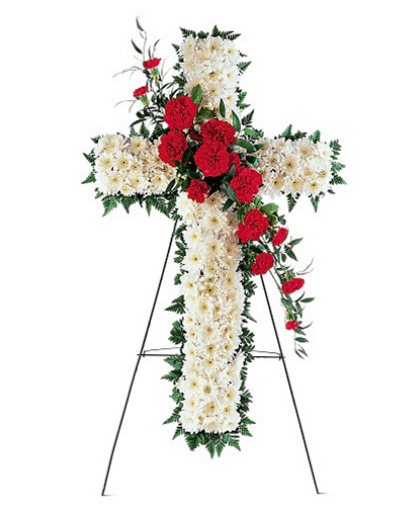
Wreaths are what many people picture when they think of funeral flowers. The circle is a traditional symbol of eternal life, and they come as solid massed designs or looser mixed-flower rings. A floral cross is a natural fit for a church service. Heart-shaped designs are more personal and usually come from family or very close friends.
Name, letter, and pillow tributes
Spelled-out tributes such as “MOM,” “DAD,” or “NANA,” and cushion or pillow shapes, are among the most personal pieces and are almost always ordered by close family. They’re built by hand on foam frames, so allow at least 48 hours and expect to call the florist rather than order from a standard catalog.
Baskets and floor arrangements
Funeral baskets are practical. They travel well from the funeral home to the graveside or reception, and the family can take them home afterward. Floor baskets are larger versions that sit beside the casket or urn.
Vase arrangements and posies
Vased arrangements work in both settings. They look right at a visitation and are just as welcome at the family’s home. A hand-tied posy is lovely for the home, but it isn’t ideal for a service because it won’t stay upright in transit.
Plants and dish gardens
A peace lily, orchid, or dish garden lasts far longer than cut flowers, and many families appreciate having something living to care for. Plants are usually sent to the home rather than the service.
Not sure which arrangement to choose?
Blooms Today’s phone team can help you match an arrangement to your budget and relationship, and confirm delivery details with the funeral home.
Call (800) 317-4807See standing sprays, wreaths, and baskets
Flowers for a cremation or memorial service
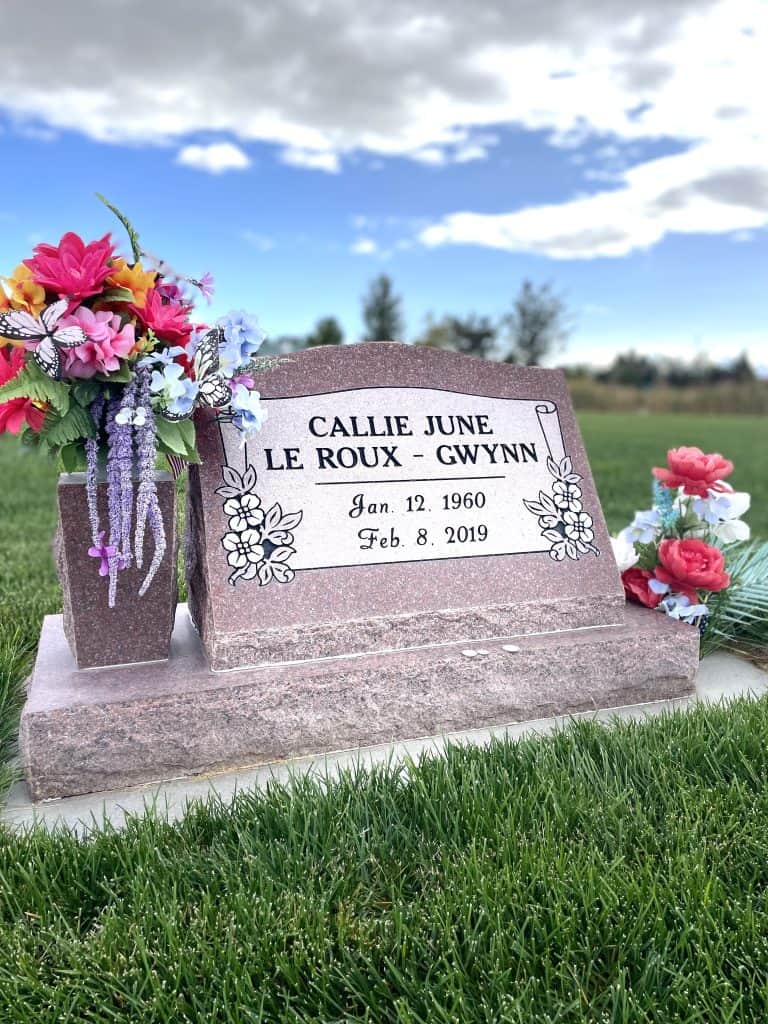
Cremation is now the choice for more than six in ten American families (the Cremation Association of North America reported a 62.8% cremation rate for 2025), and that changes how flowers are used. Yes, you should still send flowers when a family chooses cremation. They’re just as welcome. What changes is the where and the when.
- If there’s a service before cremation, it’s handled much like a traditional funeral, and you can send the same arrangements to the funeral home.
- If the memorial comes later, sometimes weeks later and at a church, park, restaurant, or family home, confirm the date and venue and make sure someone will be there to receive a delivery. When in doubt, send to the family’s home.
- If there’s no service at all (direct cremation), sympathy flowers or a plant sent to the home are the right choice.
At a memorial with the urn present, flowers are usually arranged around the urn and a photograph rather than over a casket. Some florists now offer arrangements designed for this, including wreaths that frame an urn and low arrangements that sit beside it. You’ll also find ideas in our guide to ash scattering, since loose petals are often part of scattering ceremonies.
Flowers designed for cremation memorials
Blooms Today has a dedicated collection for cremation services, including urn wreaths, floor baskets, and table arrangements, priced from about $85 to $150 with delivery included.
How much do funeral flowers cost?
Most people spend between $75 and $150 on funeral or sympathy flowers. At national online florists in 2026, a simple vase arrangement or sympathy basket starts around $60 to $85 with delivery, a standing spray runs about $135 to $350, and a casket spray usually costs $250 to $700 or more depending on size and flowers.
There’s no rule about what you “should” spend, but this is roughly what’s typical:
| Your relationship | Typical spend | Common choices |
|---|---|---|
| Coworker, neighbor, or acquaintance | $50–$100 | Vase arrangement, basket, or plant |
| Friend | $75–$150 | Basket, vase arrangement, or small standing spray |
| Group or office collection | $100–$250 | Standing spray, wreath, or floor basket |
| Close friend or extended family | $100–$250 | Standing spray, wreath, or cross |
| Immediate family | $250–$700+ | Casket spray, name tribute, or large standing piece |
Why are funeral flowers so expensive?
It’s a fair question when an arrangement will be on display for a day. A few things drive the price. Funeral pieces use a lot of stems and foliage, plus easels, foam frames, and ribbon. They’re made to order on short deadlines and hand-delivered to a specific place at a specific time. And when you order through a national website or wire service, part of what you pay covers the order-taking and relay to a local florist, who then builds and delivers the arrangement.
That’s also why some families ask for donations in lieu of flowers. It isn’t a rejection of the gesture, just a preference for something that lasts longer.
How to save money on funeral flowers
Your respect for the person who died isn’t measured by the size of the arrangement. Families notice who reached out far more than what it cost. If you’re watching your budget, these tips help:
- Compare the total price. Some sites show a low arrangement price and add delivery and service fees at checkout. Look for prices that include delivery.
- Choose a smaller piece, or a plant. A well-made vase arrangement or peace lily is always appropriate, and it’s something the family can take home.
- Go in with others. A single standing spray from a group of coworkers or friends costs each person less and looks more substantial than several small arrangements.
- Let the florist choose seasonal flowers. Asking for a “designer’s choice” in your color palette often gets you more for the money than insisting on specific stems.
- Check the funeral home’s pricing before ordering through them. Many funeral homes will arrange flowers for you, which is convenient, but some add a service charge. Flowers ordered this way are a “cash advance” item under the FTC Funeral Rule, and the funeral home has to state on your itemized bill if it charges for obtaining them or keeps a commission or discount.
- Call a local florist near the funeral home directly. Florists close to the funeral home know its delivery routine, and ordering direct can avoid relay fees.
- Read the fine print on memberships. Some online florists, Blooms Today included, offer a discount if you join a paid membership program at checkout. Blooms Rewards costs $9.99 a month and renews automatically until you cancel, so only add it if you’ll actually use it.
- Make your own. A tribute from your garden or a flower market can be deeply personal. We’ve put together tips on creating your own memorial tributes.
If you’re also helping to arrange the funeral itself, our guide on how to save money arranging a funeral or cremation covers the larger costs.
How to send flowers to a funeral home
Sending flowers to a funeral home, even one in another state, is straightforward as long as you have the right details. Have these ready before you order online or by phone:
- The full name of the person who died (the funeral home may be handling several services that day)
- The funeral home’s name, street address, and phone number
- The date and start time of the viewing or service, and the time zone if it’s out of state
- Your card message, signed with your full name so the family knows who to thank
Then:
- Ask for delivery at least two hours before the service. For an evening visitation, delivery the same morning or the day before is ideal.
- Call the funeral home if the service is at a church or other venue. Many will accept flowers and bring them to the service. Delivering to an unattended church or hall risks flowers sitting outside or being missed.
- Ask for delivery confirmation. A reputable florist will confirm when the arrangement has arrived.
For sympathy flowers to a home, check that someone will be there to receive them, especially in hot weather.
Want someone to handle the details?
Call Blooms Today at (800) 317-4807, give them the funeral home and service time, and they’ll arrange delivery through a local florist near the funeral home.
When to order funeral flowers, and when they should arrive
| What you’re sending | Order by | Aim to deliver |
|---|---|---|
| Standard funeral arrangement | At least 24 hours ahead | 2+ hours before the viewing or service |
| Casket spray, name tribute, custom piece | 48 hours or more ahead | Morning of the service, or the day before |
| Sympathy flowers to the home | Any time | As soon as you hear, or within the first week or two |
| Flowers for a later memorial | A few days ahead | The morning of the memorial, with someone there to receive |
Short on time? Same-day delivery is possible in most areas. Blooms Today, for example, accepts same-day orders until 12:00 p.m. Monday through Friday, 11:00 a.m. Saturday, and 10:00 a.m. Sunday in the recipient’s time zone. Florists generally deliver to businesses such as funeral homes by 5:00 p.m., so for a morning service, order the day before.
Don’t worry if you’ve missed the funeral. Sympathy flowers that arrive a week or two later are often the most appreciated, because that’s when the calls and casseroles stop and the house gets quiet. A small arrangement on the first anniversary, or on the person’s birthday, lets the family know they haven’t been forgotten.
What to write on a funeral flower card
Keep it short. The flowers carry most of the message, and a few sincere words are better than something elaborate. Address the card to the family rather than the person who died, unless the flowers are from immediate family. Save longer memories for a sympathy card or letter.
From friends, neighbors, or coworkers
- With deepest sympathy, [your full name]
- Thinking of you and your family. With love, [name]
- [Name] will be deeply missed. Holding you close, [name]
- With heartfelt condolences from all of us at [company or team]
- We’re so sorry for your loss. [Name] made our days brighter.
From family
- Forever in our hearts, Mom
- In loving memory of our dear Dad and Grandpa
- Always loved, never forgotten. Your loving children
- Rest peacefully, [name]. We love you.
If you’re unsure of the family’s faith
Stick to messages of love and remembrance, such as “Thinking of you” or “In loving memory.” Save religious wording like “in our prayers” for families you know share that faith.
Flower meanings and colors
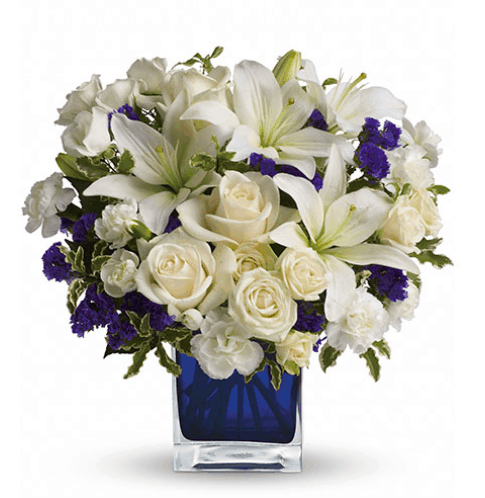
You don’t need to know the language of flowers to send something appropriate. White is always a safe choice. But if you’d like your arrangement to say something specific, these are the traditional associations:
| Flower or color | Traditional meaning | Notes |
|---|---|---|
| Lilies (especially white) | Peace, innocence restored to the soul | The classic funeral flower; strongly scented |
| Roses | Red: love and respect. White: purity. Yellow: friendship. Pink: grace and gratitude | Versatile and suitable from anyone |
| Chrysanthemums | Honor, grief, remembrance | Widely used in the U.S.; in parts of Europe and Asia they’re reserved for funerals |
| Carnations | Remembrance (pink), pure love (white) | Long-lasting and budget-friendly |
| Gladioli | Strength of character, integrity | Common in tall standing sprays |
| Orchids | Enduring love, beauty | Often sent as a potted plant |
| Peace lily (plant) | Peace, hope | Popular sympathy plant; toxic to cats and dogs |
| Blue and purple tones | Calm, dignity, respect | Good for a man’s service or a quiet, understated look |
Color can also tell part of a person’s story: a favorite color, a team’s colors, the flag of a family’s homeland, or red, white, and blue for a veteran. A good florist will build around whatever you tell them.
Religious and cultural customs
Flowers are expected at most American funerals, but not every tradition uses them. Customs vary between families and congregations, so treat these as general guidance and check with the family or funeral home if you’re unsure.
| Tradition | Are flowers customary? | What’s appreciated |
|---|---|---|
| Protestant Christian | Yes | Funeral flowers at the service and sympathy flowers at home |
| Catholic | Yes, at the funeral home and vigil | Flowers at the wake; some parishes limit flowers in the church during the funeral Mass. Mass cards are also a traditional gesture |
| Latter-day Saint | Yes | Arrangements at the service; crosses are not typically used |
| Eastern Orthodox | Yes | White flowers are traditional |
| Jewish | Generally no | Food for the shiva home, a fruit basket, or a donation. Some Reform families welcome flowers, so check first |
| Muslim | Generally no | Burial happens quickly and simply. Meals for the family or a charitable donation are more appropriate |
| Hindu | Not usually sent by guests | The family often provides flowers for rites. Fruit or food for the home is a common gesture |
| Buddhist | Yes | White or yellow flowers; avoid red, which is associated with celebration |
| Chinese and many East Asian traditions | Yes | White and yellow chrysanthemums; avoid red |
Flowers for a child, a veteran, or from a group
Funeral flowers for a child
There’s nothing harder than a child’s funeral, and many people freeze when choosing flowers. Keep it gentle and simple. Soft whites and pastels, or the child’s favorite color, are always appropriate. Some families welcome a small stuffed animal or a nod to a favorite sport or hobby tucked into an arrangement. If you’re unsure, a plant or small arrangement sent to the home is a quiet, kind gesture.
Patriotic funeral flowers for a veteran

Red, white, and blue arrangements are a fitting tribute for someone who served, or simply loved their country. Red roses or carnations, white lilies, and blue delphinium or statice make a striking combination, and ribbon can supply a color that’s hard to find in flowers. A white arrangement trimmed with red and blue ribbon is dignified and understated.
A patriotic tribute
Blooms Today’s America the Beautiful arrangement combines red roses, white lilies, carnations, and blue statice with a small American flag, from $90 with delivery.
Flowers from an office, team, or group
Group flowers work best when one person takes charge. Collect contributions, choose one larger piece such as a standing spray or wreath, and sign the card with the group’s name (“With deepest sympathy from your colleagues at…”). If some people knew the family well, they may also want to send something personal to the home.
When not to send flowers, and good alternatives
Skip funeral flowers when the family has asked for donations instead, when their faith doesn’t use them, or when there’s no service to deliver to. In those cases, you still have plenty of ways to show you care:
- A donation to the charity named in the obituary
- A meal, or a food or fruit basket for the home. After the first week, practical help is often welcomed more than anything else
- A plant the family can keep
- A handwritten card with a memory of the person. Families reread these for years
- Your time: school pickups, walking the dog, help with the paperwork
If you’re the one planning the service, our step-by-step guide to planning a funeral service can help with everything beyond the flowers.
Frequently asked questions
Yes. It’s the most common place to send funeral flowers. Funeral directors receive, display, and move flowers to the service or graveside, and they make sure the family sees the cards. Give the florist the full name of the person who died and the service date and time.
Order online or by phone from a florist that delivers nationwide, or call a florist in the funeral home’s town. Double-check the service time zone, because same-day cutoffs are based on the recipient’s local time.
The immediate family, usually the spouse or children, often arranged through the funeral director. Other relatives and friends send standing sprays, wreaths, or baskets instead.
You can, but it’s easier on everyone to have them delivered ahead of time so staff can place them before guests arrive. If you do bring flowers, choose something small and hand it to a funeral home staff member rather than the family. A single flower to place on the casket or at the graveside is also a lovely gesture where the family invites it.
No. Sympathy flowers sent to the home in the weeks after a funeral are often especially meaningful, because that’s when support tends to fall away.
The family usually takes some arrangements home, and others go to the graveside or the reception. Some families ask the funeral home to donate them to a hospital, nursing home, or church. Cards are collected and given to the family.
“In lieu of” means “instead of.” The family is asking for donations to a named charity rather than flowers. It’s polite to follow the request.
Whatever you send, and whenever it arrives, the gesture matters more than the arrangement. Families rarely remember exactly which flowers came from whom. They remember who reached out.
Ready to send funeral or sympathy flowers?
Order online or call Blooms Today at (800) 317-4807. Prices include delivery and service, with same-day delivery available in most areas.


