For most of modern history, families in the United States have had two realistic choices for a loved one’s body: burial or flame cremation. That is changing. A third option — known technically as alkaline hydrolysis, and more commonly as water cremation or aquamation — is now legal in more than half of U.S. states and is quietly reshaping how Americans think about a final farewell.
Water cremation uses water, alkaline chemicals, and gentle heat to return a body to its natural elements. It produces no flame and no direct emissions, uses a fraction of the energy of a conventional cremator, and gives families back a fine white ash much like the one they would receive from flame cremation. For people drawn to a softer, greener goodbye, it has become an option worth understanding properly.
This guide explains exactly what water cremation is, how the process works step by step, what it costs, where it is legal, how it compares with flame cremation and burial, and how to arrange one. It is written to help you make a calm, informed decision — whether you are planning ahead for yourself or making arrangements for someone you love.
🌿 Aquamation (Water Cremation): Key Takeaways
Aquamation, also called water cremation or alkaline hydrolysis, is an eco-friendly alternative to flame cremation that uses warm water and alkali to gently reduce the body to bone remains.
- 💧 Uses water instead of flame – Aquamation is often described as a gentler, more environmentally conscious alternative to traditional cremation.
- 🌎 Lower environmental impact – Water cremation uses significantly less energy and produces fewer emissions than flame cremation.
- ⚱️ Families still receive ashes – Similar to cremation, loved ones receive cremated remains (often a greater volume of ash than flame cremation).
- 💲 Typical costs range from $2,500–$4,500 – Prices vary depending on location, funeral provider, and services selected. Simple direct options start near $1,000; full-service can reach $5,000+.
- 📍 Legal in 26 U.S. states (2026) – Aquamation is legal in 26 states, though provider access can still be limited in some regions.
- 🌿 Popular with eco-conscious families – Families considering green burial or lower-impact end-of-life choices often explore aquamation as an alternative.
Bottom line: Aquamation offers families a more environmentally friendly alternative to cremation while still allowing for memorial services, urn placement, ash scattering, or keepsake memorialization.
Explore water cremation
This guide is the hub of our complete resource on water cremation. For a deeper dive into any one topic, follow the links below:
- Where is aquamation legal? — a current, state-by-state breakdown of water cremation laws.
- Aquamation provider directory — find water cremation providers across the United States.
- How much does water cremation cost? — a full breakdown of pricing, what’s included, and how to compare quotes.
- Aquamation vs. cremation vs. burial — a side-by-side comparison to help you choose.
What is water cremation?
Water cremation is a method of final disposition that uses alkaline hydrolysis — a water-based chemical process — to reduce a body to its essential elements. It is also marketed as aquamation, bio-cremation, flameless cremation, green cremation, resomation, and liquid cremation. The names differ; the underlying process is the same.
Where flame cremation uses intense heat and combustion to reduce a body, water cremation uses water combined with a strong alkali — usually potassium hydroxide or sodium hydroxide — held at an elevated temperature. This accelerates the same natural breakdown that would occur over many years in the ground, completing it in a matter of hours. As the Cremation Association of North America (CANA) puts it, the decomposition that takes place in alkaline hydrolysis is the same as that which occurs during burial — simply sped up dramatically.
What remains at the end are two things: bone fragments, which are dried and processed into a fine white ash, and a sterile liquid containing salts, sugars, amino acids, and peptides. There is no tissue and no DNA left in the liquid once the process is complete.
Importantly, alkaline hydrolysis is recognised as a legitimate form of disposition by major industry bodies. CANA expanded its definition of cremation to include the process back in 2010, and most states that have legalised it have done so by treating it as a form of cremation under the law. From a family’s perspective, the experience — arranging the service, receiving an urn of ashes, choosing how to memorialise — is very similar to flame cremation.
How does water cremation work? A step-by-step look
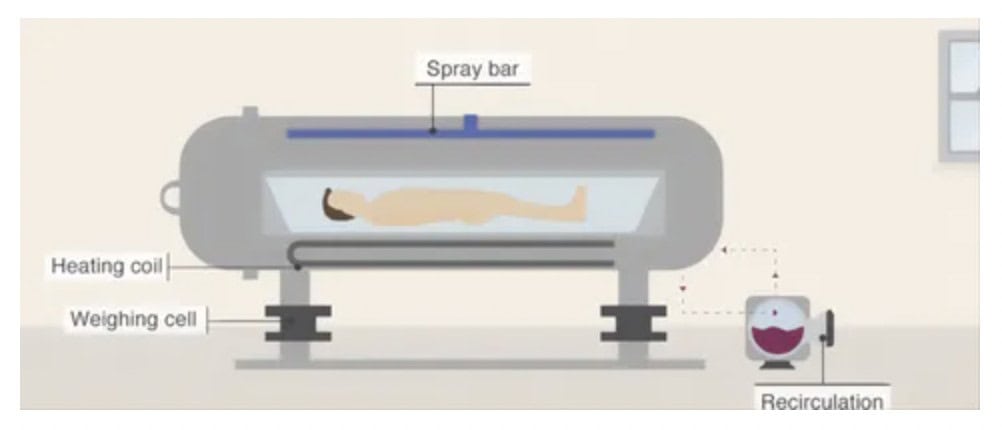
Understanding the process can bring real reassurance. Here is what happens, from the moment a body arrives at a water cremation facility to the moment the ashes are returned.
1. Transfer, identification, and preparation. The body is transported to a licensed facility and held in appropriate refrigerated storage until the process begins. Identification and chain-of-custody procedures are followed throughout, just as they are with flame cremation. One practical difference: because there is no flame, pacemakers and other implants do not need to be removed beforehand (unless a state’s rules require it), since they are not exposed to extreme heat. The body is placed in a biodegradable pouch or container designed to break down during the process.
2. The hydrolysis vessel. The body is placed inside a single, watertight stainless-steel chamber. The chamber is filled with a solution of roughly 95% water and 5% alkaline chemical. The exact quantity of water and chemical is calibrated to the individual — body weight, mass, and other factors determine the mix — so the process is tailored to each person.
3. The process runs. The chamber is sealed and the solution is brought to an elevated temperature — generally between 199°F and 302°F, depending on the equipment — sometimes under pressure, with gentle circulation of the liquid. Over a period of roughly three to sixteen hours, again depending on the equipment and the size of the body, the soft tissue is gently broken down and dissolved into the liquid. The skeleton remains.
4. Recovering and processing the remains. Once the cycle finishes, the bone fragments are carefully removed. Because the process uses water rather than fire, the remains are first allowed to dry. They are then processed into a fine, uniform powder — pure white in colour — which is what the family receives. Any non-organic items, such as dental work or implant materials, are separated out at this stage.
5. The liquid is released. The remaining liquid, often called effluent, is sterile. Its pH is brought up to a safe level — at least 11 — before it is released into the wastewater system in accordance with federal, state, and local rules. Wastewater treatment authorities generally welcome it; the liquid is far cleaner than ordinary wastewater, and in some cases it is diverted for use as fertiliser because of its nutrient content.
6. The ashes are returned. The processed remains are placed in an urn or a temporary container and returned to the family, who can keep, scatter, bury, or otherwise memorialise them — exactly as they would with flame-cremation ashes.
What you receive afterwards

Families are often unsure what to expect at the end of the process. The result is reassuringly familiar: a quantity of fine, dry, white ash, returned in an urn or container of your choosing.
There are two small differences worth knowing. First, the ash from water cremation tends to be a paler, more uniform white than flame-cremation ashes, which can carry a greyish tone. Second, water cremation typically returns more ash — CANA estimates roughly 32% more than flame cremation. This is simply because the process is gentler on the bone. It is a minor point, but a practical one: you may want a slightly larger urn than you would choose for flame-cremation ashes.
As for the liquid, it is worth addressing directly, because it is the part of the process families most often ask about. The effluent contains no tissue and no DNA. It is, in chemical terms, a sterile solution of the basic building blocks of life — salts, sugars, amino acids, peptides. It is not “your loved one”; just as flame cremation converts soft tissue into gases and water vapour released into the air, water cremation converts it into harmless compounds released with water. The remains of your loved one are the bones — and those are returned to you.
The environmental case for water cremation
For many families, the environmental footprint of a final disposition has become part of the decision. This is one of the strongest arguments in favor of water cremation.
Flame cremation is energy-intensive. It requires sustained, very high temperatures, typically fuelled by natural gas, and it releases carbon dioxide and other emissions — including mercury vapor from dental amalgam — into the atmosphere. Conventional burial carries its own environmental costs: land use, embalming chemicals, and the materials in caskets and vaults.
Water cremation avoids much of this. There is no combustion, so there are no direct emissions and no mercury released into the air. Exact energy figures vary by equipment and by source, but the direction is consistent: state legislative analyses describe the process as using a small fraction of the energy of flame cremation. Pennsylvania’s 2025 legislative memo on its aquamation bill cited energy use roughly 90% lower than flame cremation, while Hawaii’s 2022 legislation referenced about one-eighth the energy of a flame crematory and a 75% reduction in carbon emissions. CANA describes alkaline hydrolysis as using significantly less fuel, with a lower overall carbon footprint than both flame cremation and burial.
The main environmental input is water, and a significant quantity is used per cycle. But the liquid that leaves the process is benign — cleaner than typical wastewater, and treated as a welcome addition to municipal water systems. For families weighing their final environmental impact, water cremation is, on balance, among the gentlest options available.
The advantages and drawbacks
No single method of disposition is right for everyone. Here is a balanced view.
Advantages
- A gentler process. Many families are drawn to water cremation precisely because it involves no fire. For those uneasy about flame cremation, the idea of a water-based process can bring genuine comfort.
- A smaller environmental footprint. No combustion emissions, no mercury release, and far lower energy use than flame cremation.
- Familiar results. You receive ashes you can keep, scatter, bury, or place in keepsakes — the same memorial options as flame cremation.
- No need to remove implants. Pacemakers and similar devices do not have to be removed beforehand.
- A respectful, dignified procedure carried out in licensed facilities by trained operators.
Drawbacks
- Limited availability. Although legal in 26 states, water cremation is not yet offered everywhere. In some legal states there is no operating facility at all.
- Cost can be comparable to or higher than flame cremation. It is not always the cheapest option (see the cost section below).
- It is less familiar. Some relatives may simply not have heard of it, which can make family conversations harder.
- Religious acceptance varies. Not all faith traditions accept it (see the section on religious views).
- The idea takes some getting used to. For a minority of people, a water-based process is harder to picture than a more traditional method. Understanding how it works usually helps.
Who chooses water cremation?
There is no single profile, but some themes recur. Environmentally conscious families often choose it as the option that best reflects a life lived with care for the planet. People uncomfortable with flame — for personal, emotional, or sometimes cultural reasons — are drawn to a gentler alternative that still produces ashes. Some choose it for its simplicity and dignity, valuing a quiet, contained process.
It is also chosen by families who have done their research and concluded that, for them, it is the most considered farewell available. Because the end result is ashes, water cremation fits comfortably with almost any kind of memorial — a service before or after the process, a scattering, a burial of ashes, or keepsake urns and jewellery shared among family.
Religious and cultural views
Faith and culture shape end-of-life choices deeply, and views on water cremation are not uniform.
The Catholic Church does not approve of alkaline hydrolysis. In a March 2023 statement, On the Proper Disposition of Bodily Remains, the United States Conference of Catholic Bishops took the position that the process does not show adequate respect for the human body. Catholic families considering water cremation should speak with their priest or diocese.
Other Christian denominations vary, and many leave the decision to individual conscience, much as they do with flame cremation. Some traditions that discourage any form of cremation will likewise discourage water cremation; others that accept cremation tend to extend that acceptance. Within Judaism and Islam, traditional teaching generally favours prompt earth burial and is typically not aligned with cremation in any form, though practice varies among individuals and communities.
There are also traditions for which water cremation holds positive cultural resonance. When Hawaii legalised the process in 2022, lawmakers and Native Hawaiian advocates pointed to its alignment with traditional Native Hawaiian burial practices, which historically sought to leave only the bones. For some communities, in other words, a water-based process is not a departure from tradition but a return toward it.
Because these questions are personal and specific, the most reliable guidance comes from speaking with a religious leader, family members, or a cultural authority you trust before making a final decision.
How water cremation compares with flame cremation and burial
At a glance, water cremation sits between traditional cremation and green burial — it produces ashes like flame cremation, but with an environmental profile closer to natural burial.
Compared with flame cremation, water cremation uses far less energy, produces no direct emissions, takes somewhat longer per individual, and returns slightly more ash. Cost is broadly comparable, though it varies by provider and region. Both return ashes and allow the same memorial options.
Compared with conventional burial, water cremation requires no grave plot, no embalming, and no casket or vault, and it has a much smaller land and materials footprint. It is generally far less expensive than a full burial.
Compared with natural or green burial, the two share an environmental ethos, but the outcome differs: green burial returns the body to the earth directly, while water cremation returns ashes to the family.
How much does water cremation cost?
Cost is one of the first questions families ask, and the honest answer is that it varies — by provider, by region, and by how much service you want around the process itself.
Based on the providers listed in our aquamation provider directory, a water cremation in the United States typically costs between $2,500 and $4,500. At the lower end, a simple direct water cremation — with no viewing or formal service — can be found from around $1,000 to $1,500 in some areas. At the upper end, full-service arrangements that include a viewing, a memorial service, and additional options can reach $5,000 or more.
In broad terms, water cremation is often priced comparably to flame cremation, sometimes slightly higher because the equipment is specialised and not yet widespread. As more facilities open, prices may become more competitive.
If affordability is your priority, it is always worth asking each provider for a fully itemised price list and comparing like with like — a direct water cremation against a direct flame cremation, for example. Our partner site DFS Memorials specialises in connecting families with low-cost cremation providers and can be a useful starting point when budget is the main concern.
For a complete breakdown of water cremation pricing — what is included, why prices vary, real provider prices by state, and how to compare quotes — see our full water cremation cost guide.
Where is water cremation legal?
Because funeral and disposition laws are set at the state level, the legality of water cremation depends entirely on where you live. As of 2026, alkaline hydrolysis is recognised as legal in 26 U.S. states, according to data maintained by the Cremation Association of North America and the National Funeral Directors Association.
There is, however, an important distinction between legal and available. A state can permit water cremation while having no operating facility within its borders. In that situation, families have two practical paths: work directly with a licensed facility in a neighbouring state, or use a local funeral home that will arrange transport of the body to an out-of-state facility and return the ashes locally. Either way, it is wise to make these arrangements in advance, as costs and timelines vary.
A small number of states have legislation pending — Pennsylvania, where a bill passed the state House in the 2025–26 session, is the most advanced — while one state, New Hampshire, currently prohibits the practice outright.
For the current status in your specific state, see our continually updated guide: where is aquamation legal?
How to arrange a water cremation

If you have decided that water cremation is the right choice, here is how to move forward.
Confirm it is legal and available where you are. Start with our legal status guide to check your state, then consult our provider directory to see whether a facility is within reach. If your state permits the process but has no local facility, look at neighboring states.
Choose a provider and ask the right questions. When you contact a provider, ask plainly: Do you perform alkaline hydrolysis on-site, or do you arrange transport to another facility? If transport is involved, ask how that affects permits, timing, and cost. Ask for a fully itemized written price list — providers are required to be transparent about pricing, and comparing itemized quotes is the single most useful thing you can do.
Decide on the service around the process. Water cremation, like flame cremation, can be as simple or as full as you wish. You might choose a direct water cremation with a private family gathering afterward, or a viewing and a formal service beforehand. Decide what will bring your family the most comfort.
Plan for the ashes. Think ahead about what you would like to do with the remains — keeping them in an urn, scattering in a meaningful place, burying them, or sharing keepsakes among family members. Because water cremation returns slightly more ash than flame cremation, mention this when selecting an urn.
Take your time where you can. If you are pre-planning, you have the luxury of considering everything carefully. If you are arranging for someone who has died, lean on the provider’s guidance — a good one will walk you through every step without rushing you.
A brief history of alkaline hydrolysis
Although it feels modern, the underlying science is more than a century old. Alkaline hydrolysis was first developed and patented in 1888 by Amos Herbert Hanson, a farmer looking for a way to turn animal remains into fertiliser.
Its use on human remains came much later. In 1993, the first commercial system for human use was installed at Albany Medical College to handle the bodies of donors to its anatomical program. Over the following years, universities and medical institutions with body-donation programs adopted the process — the Mayo Clinic notably used it for its anatomical bequest program, and Minnesota became the first U.S. state to legalize it for general use in 2003.
The process entered the funeral profession itself in 2011, first offered to families by two funeral homes — one in Ohio and one in Florida. Since then, state after state has legalized it, and what began as a quiet practice within medical institutions has become a recognized mainstream option for families across much of the country.
Frequently asked questions
Is water cremation the same as aquamation?
Yes. Water cremation, aquamation, alkaline hydrolysis, bio-cremation, resomation, flameless cremation, and green cremation are all names for the same water-based process. “Alkaline hydrolysis” is the technical term; “water cremation” and “aquamation” are the names most often used with families.
Is water cremation the same as cremation?
It achieves a similar result — returning a body to bone fragments that are processed into ash — but by a different method. Flame cremation uses heat and combustion; water cremation uses water, alkaline chemicals, and gentle heat. Most states treat alkaline hydrolysis as a form of cremation under the law.
How long does water cremation take?
The process itself generally takes between three and sixteen hours, depending on the equipment used and the size of the body. The full arrangement, including paperwork and the return of the ashes, takes a similar overall timeframe to flame cremation.
What do you get back after water cremation?
You receive a fine, dry, white ash — the processed bone remains — returned in an urn or container of your choice. It is similar to flame-cremation ashes, though typically paler and slightly greater in quantity.
How much does water cremation cost?
A water cremation in the U.S. typically costs between ,500 and ,500. Simple direct options can be found from around ,000 to ,500, while full-service arrangements can reach ,000 or more.
Is water cremation legal where I live?
It is legal in 26 U.S. states as of 2026, though not every legal state has an operating facility. Check our state-by-state legal guide for your specific state.
Is water cremation environmentally safe?
Yes. It produces no direct combustion emissions and no mercury release, and uses far less energy than flame cremation. The liquid that leaves the process is sterile, contains no DNA, and is treated as a benign addition to the wastewater system.
What happens to the liquid?
The liquid, or effluent, is sterile and contains no tissue or DNA. Its pH is adjusted to a safe level and it is released into the municipal wastewater system in accordance with the law. In some cases it is used as fertilizer.
Does the Catholic Church allow water cremation?
No. In a 2023 statement, the U.S. Conference of Catholic Bishops took the position that alkaline hydrolysis does not show adequate respect for the body. Catholic families should consult their priest or diocese.
Can I have a viewing or funeral service with water cremation?
Yes. As with flame cremation, you can hold a viewing or a full funeral service before the process, or a memorial service afterward. Water cremation places no restriction on the kind of service you choose.
Can pets be water cremated?
Yes — pet aquamation is widely available and is, in fact, legal for pets across the country. It is a distinct service from human water cremation, and we cover it separately.
In summary
Water cremation gives families a third path — one that produces familiar ashes through a gentle, low-emission process. It is now legal across much of the United States, broadly comparable in cost to flame cremation, and accepted as a legitimate form of disposition by the funeral industry’s major bodies.
If it is an option you are considering, the next steps are simple: check whether it is legal and available in your state, and explore the provider directory to find a service near you.
Part of our Complete Guide to Cremation
This water cremation (aquamation) guide is part of our complete cremation resource. Explore more:
- The Complete Guide to Cremation — how cremation works, costs, options & your rights
- Average Cost of Cremation — national & state-by-state pricing
- Compare Cremation Providers — top U.S. cremation brands & prices
- Cremation Laws Explained
- Related: Water Cremation Cost, Aquamation Providers, Human Composting


